Agricultural
Cattle Waterers and Livestock Water Lines in Northeast Kansas
Trenching water lines to tanks and waterers so livestock have reliable water year-round.
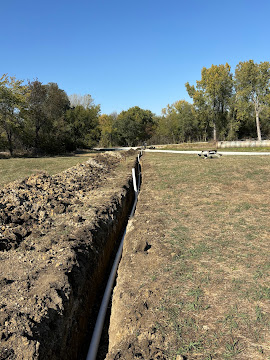
Cattle waterers and livestock water lines is getting reliable water to your tanks and your waterers year-round — trenching a line from the well or the rural water tap out to the pasture, setting a waterer or a hydrant that won't freeze, and keeping water flowing through a Kansas winter when everything else is frozen solid. It's one of the most useful rural jobs we do.
A livestock water line is a buried pipe from the source to the tank, set below frost, often with a hydrant or a drain-back waterer that empties the standing water so it can't freeze. The depth, the drain-back, and the outlet are what keep a waterer alive in January — a line that holds water above frost will split and leave your cattle dry in the worst week of the year. We plan for the cold from the start.
We trench the line out to the pasture — sometimes a long run across a field — set the hydrant or the waterer at the tank, and get the connections right at the source. If you're on rural water we coordinate with the district on the tap. If you're on a well we tie in at the well house. The point is water at the tank, every day, without you having to haul it or chop ice.
A good livestock water setup has a drain-back or a frost-free hydrant so the water empties below frost when the cattle stop drinking, a tank or a waterer sized to the herd, and a line deep enough that the frost never reaches it. We set it up so you're not out there with a torch every morning. A bad setup is a shallow line that freezes, splits, and leaves you hauling water all winter.
The cost tracks the length of the run, the depth, the soil, the number of waterers, and whether the source connection needs anything special. A long run across a field is more trench. A single waterer close to the well is less. We look at where the water is, where it needs to go, and how many head you're watering.
Tell us where the water comes from, where it needs to go, and how many cattle you're watering. We'll come look at the run, the depth, and the setup and give you a straight answer on what it takes to keep water in the tank all year.
What affects the cost
We don't quote a number without seeing the ground. These are the things that change what a job takes — call us and we'll give you a real answer for your place.
- Length of the run from the source to the waterer
- Depth below frost — deeper is more trench
- The number of waterers or hydrants along the run
- Soil type and whether the run crosses a field, a lane, or a drive
- The source connection — well, rural water tap, or existing line
What to have ready before you call
- Where the water comes from — well, rural water, or an existing line
- Where the waterer or the tank needs to be
- How many head you're watering and how many waterers you need
- The length of the run and what it crosses
- Whether you've already got a waterer or need one set
What happens on the day
We trench the line from the source to the waterer, below frost, with the pipe bedded clean. We set the hydrant or the waterer at the tank with a drain-back so the standing water empties below frost. We make the connections at the source and the waterer, backfill and compact, and shape the surface. We run the water and check the flow and the drain-back before we leave so you know it works.
Cattle Waterers and Livestock Water Lines — questions
The things folks ask us about cattle waterers and livestock water lines in Northeast Kansas.
Related services
Where we work
Based in Mayetta, Kansas, we travel to the customer across eight counties in Northeast Kansas. This map is centered on our service area — pan and zoom to see how far your property is from us. We come to you.
Get a Straight Answer on Your Job
Tell us what you need done and where. We'll call you back with a real answer.